
I’m not a millionaire writer, but I know someone who is. These are 22 rules from writer and businessman Nicolas Cole from his YouTube channel. (The full video is embedded below.)
These aren’t your boring “don’t use adverbs” rules. They go much deeper…
1. You can’t steer a stationary ship
Too many people overthink and try to solve problems they don’t have yet when they haven’t even taken the first step. Nicolas gives a great example. It’s like when someone tells a basketball coach, “I want to learn how to shoot like Kobe Bryant.”
“Alright, I’ll see you at the gym tomorrow.”
“No, I don’t need to come to the gym. I just need to learn the moves like Kobe.”
We try to go to step 100 before even taking step one.
You can’t improve something when it isn’t in motion. Just start writing to get your ship moving, then you can steer it as you get more practice.
2. Volume wins
Nicolas says, “The right way to write is often.” Everything is more successful with volume.
I’m so happy to be reminded of this one. I’ve been having trouble with writing consistently lately for many reasons, but the biggest reason is just that I overthink everything.
This causes me to sit around twiddling my thumbs, wondering what I should write about. “This kind of article gets the most reads, but I’m tired of writing about that. But wait. I need to solve a problem. But what problem?!”
I waste so much time thinking and not enough time doing.
If that’s you too, Nicolas’s advice is to write and write a lot. The greatest artist, musicians, and writers that ever lived created thousands and thousands of pieces. Most of them weren’t hits. But every once in a while, you will get a hit, and it makes it all the duds worth it.
3. Create more than you consume
If you’re a creator in any capacity (writing, art, music, etc.), then you need to spend more time in your day creating versus consuming.
It’s fine to consume because it helps you get ideas (as Nicolas’s video did for me), but you need to combine the consuming with the creating and make sure creating is happening more often.
This is something I recently had to deal with. I realized I was pushing my writing time into the day where I was constantly getting distracted by my pets, kids, husband, laundry, and daily life tasks.
I love reading first thing in the morning to get my brain juices flowing, but I realized that was the perfect time to write. It’s when the house is completely quiet.
I had to reduce my reading (consuming) to increase my writing (creating).
4. Consume what you want to create
Building on rule #3, make sure to consume what you’re trying to create. If you’re a fiction writer, consume fiction. If you’re a YouTuber, consume content that helps you become a better YouTuber.
This helps you anchor your mindset to get you in the right headspace when you’re ready to create.
5. Practice before you play
Do the boring stuff that needs to be done before you do something more fun because “whoever can tolerate the most boring stuff wins.”
If a shiny object is catching your attention, go explore it after you do what you need to do for the day.
6. Simplicity is velocity
The simpler something is, the faster it can move. The more complex something is, the more friction there is, and therefore it moves slower.
No matter if you’re an entrepreneur, solopreneur, or anything in between, the entire game is making things as simple as possible.
If you want to write every day, what little complex things get in your way? How can you make it so simple that it’s easy to accomplish each day?
As I mentioned above, I had this exact problem. I was making writing daily harder for myself by not setting aside time in the morning when it’s the quietest in my house.
Little things would constantly get in my way (including my own distracted thoughts), making it harder to consistently write.
Remember…
Simple is always better.
7. Every day you don’t write, you practice not writing
This is an easy concept, yet it’s a trap too many of us fall into. You want to write (or create whatever your thing of choice is) every day because you want to turn it into a habit.
When you fall off the writing habit, it’s too easy to turn not writing into the habit. The more days you don’t write, the harder it is to get back into the writing habit.
Write daily.
This doesn’t mean you need to publish every day. Just write something every day.
8. If you can write fiction, you can write anything (or…)
Nicolas had a professor that told him, “If you can write and understand the mechanisms of fiction, every other type of writing is easy.” Fiction teaches you the art of the craft.
Nicolas says he’d tweak this a bit to say “If you can write copy, and write things that sell to people, you can write anything.”
Studying from copywriters will help your story writing techniques improve dramatically.
9. Word count is a poor measure of value
No one cares how many words something is. They care about the value of reading your piece. Nicolas says that broke writers measure their writing by word count. They charge by number of words.
But the number of words doesn’t mean anything. It’s whether those words create value for the reader.
10. Start with the big idea
Nicolas tells a story when he was visiting top copywriter, Craig Clemens. He says they both went into their rooms to start writing and came out a little while later. Craig asked Nicolas how his writing session went.
“Pretty good. I got about 1,000 words written, and I’m feeling really productive. How was it for you?”
“Good. I think I almost have the headline figured out.”
Nicolas realized that the most important thing to first focus on in a writing session is the big idea. In an article, that would be the title that ties the piece together. In a newsletter, it’s the subject line. In a book, it’s the title and subtitle.
If you can’t succinctly say the big idea in one sentence, you’re not going to know what you’re trying to say in 1,000 or 10,000 words.
Spend more time before writing thinking about the main idea of the piece and brainstorming title ideas.
11. When you write something for everyone, you write something for no one
Every time you write, think of one very specific person. Who is your ideal customer? Nicolas says that Craig taught him to create a 5–10 page biography of this person.
Give them a name. Know their wants, likes, and frustrations. What are their hopes and dreams? Their biggest problems? What have they tried in the past that didn’t work? What are their faulty beliefs? Get inside their head!
Write to this one specific person and let the internet do its job of finding the people who are just like this character.
12. Speak in benefits to the reader, not features about what makes YOU cool
The reader doesn’t care about you and how cool your products are. They only care about one thing:
“What can you do for me?”
Therefore, everything should be written as “Here’s the benefit of the thing we created for you.”
Example for a financial tech product:
“We have the most up-to-date real-time dashboard.”
Cool, but who cares? Instead, you could write:
“Our real-time dashboard is so up-to-date, you’ll never question where your money is going.”
13. Tangibles are worth more than intangibles
Intangibles are things you can’t hold, feel, or measure. Something tangible is something you can hold and feel.
Most people speak in intangibles, like “I will help you live your dream life.”
You can’t measure “live your dream life.” But you can make it tangible by speaking in objects or experiences like “I will help you retire with a million dollars in the bank by the time you’re 60.”
Always ask yourself how you can make what you’re trying to say tangible.
14. Make objective promises, not subjective promises
This goes along with #13. A subjective promise is “I will help you get healthy.” If you ask ten people what healthy means, you’ll get ten different answers. Healthy is open to different interpretations.
An objective promise is “I’ll help you lose 15 pounds of fat and gain five pounds of muscle in the next 16 weeks.”
It’s a specific goal, which makes it easier for people to understand.
15. The reader is the main character
Even if you’re writing a story about yourself, you want to frame it as a lesson that the reader can use.
Nicolas says if he were to say, “I’m going to tell you about writing online,” but then only told stories about his writing life, we would get bored. But he can tell those same stories and then add on, “…and here’s what that means for you.”
“Here’s what that experience taught me about that thing you care about. I can walk you through the things I learned so I can help you accomplish the same goal.”
You can tell your stories and experiences, as long as you turn it into something the main character (the reader) can use.
16. The size of the question dictates the size of the audience
(Note: Nicolas is talking about questions here because he’s relating his experience with the question-and-answer platform Quora. But this advice can be used with any type of writing.)
For instance, “How do I make more money?” versus “How do I make more money as a nurse living in Baltimore?”
The more specific the question, the smaller the target market.
But…
The takeaway isn’t that you should stick to broad questions. It’s that if you’re writing for a very niche audience, don’t expect mainstream viral success. And don’t expect to get a niche audience if you answer a broad question.
You need to temper your expectations based on the size of the question or target market.
17. Say what hasn’t been said
Imagine you’re writing an article about the perfect morning routine. Everyone writes the same stuff:
- Set an alarm and get up early
- Drink some coffee
- Stare at the sun
- Go for a walk
Blah, blah, blah.
We’ve heard this stuff 1,675 times.
But the game is writing something that hasn’t been said before. Nicolas says to imagine writing an article about the perfect morning routine and the first thing you recommend is taking a shot of tequila.
It doesn’t matter if you agree with it or not, what matters is that it’s different. The entire writing game is saying something that hasn’t already been said. That’s how you get attention.
If you can’t say something new, you can do the next best thing and say something that’s already been said, but in a new and different way.
Call it something different, give it a new framework, wrap it in a different way. Repackage something that’s been said in a new way, and people will think it’s something new.
18. The most important sentences are the first and last
This goes for your entire article, each section, each chapter, or each paragraph.
Of course, we all know how important a hook is, but the last sentence is just as important. You want to open a new loop in the reader’s mind, leave them with something that is thought-provoking, or leave them with a feeling of resolve that closes out the big idea.
Nicolas’s tip is to write the first sentence, then the last sentence as a kind of writing map. Then, since you know where you’re going, you can fill in the middle.
19. Skimmability is readability
If your work isn’t skimmable, no one’s going to read it. Nicolas gives an example of The New Yorker, which is still formatted for the way people read 70 years ago. I grabbed a paragraph from a random story on their site so you can see:
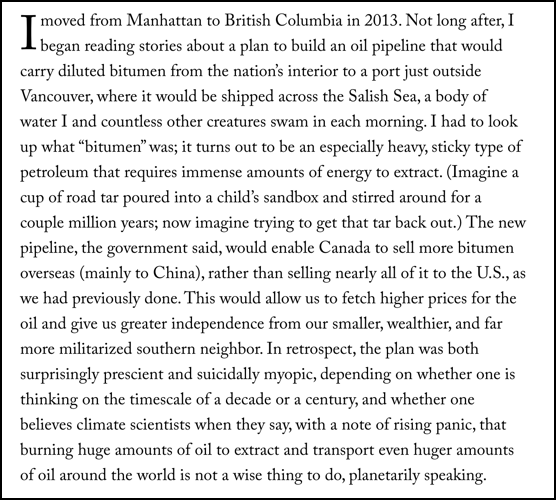
Today’s readers are used to reading short paragraphs with subheaders that are easy to skim. I’m sure people would love to argue whether this is a good or bad thing, but it doesn’t matter. It’s the way things are right now.
So, if you want people to read your work all the way through, make it skimmable with good formatting including subheaders, bolded phrases, quotes, and call outs.
You want someone to land on your work and be able to get the big idea just from skimming. It reduces the cognitive load and allows them to understand the information quickly and easily.
20. Your value is the value of your value to the reader
How much money you make as a writer (your value) is the value of what you provide to someone else. It’s not about your effort, it’s about what you can provide to your client, customer, or reader.
It’s not about your heart and soul or your time.
As mentioned in #17, if you say the same thing as 1,000 other people, you don’t bring enough value.
Ask yourself: “How do I help someone do something that solves a valuable problem or unlocks a valuable outcome?”If you can do that, you’ll be paid proportional to that outcome being unlocked.
21. If you want to learn what sells, sell something
The way to learn how to do something is to do it yourself. For instance, if you want to get good at copywriting, create a product and then try to sell it using copywriting.
Reading copywriting books is great and will help you learn the basics, but experience is your best teacher.
22. The business model is the goal
Some people think “I really want to do this thing over here, but I’m going to make money first by following this other business model, and then I’ll be able to do what I really want.”
That never ends up happening.
Your goal needs to be tied to the business model.
If you want to win the Pulitzer Prize, you’re not going to get there by building digital products. Those are two completely different goals.
If you want to win the Pulitzer Prize, you’ll have to give up everything else because that will need to become your focus to reach that goal.
Whatever business model you follow will define all of the actions you take. Be sure to pick the business model with a lot of clarity. Pick something suited to you and your lifestyle. That’s what I did here.
Final Thoughts
I hope these 22 writing rules helped you as much as they helped me. My biggest takeaways are “volume wins,” say what hasn’t been said, and to make objective, specific promises.
I would love to know which writing rules gave you the biggest “Ah-ha!” Let me know in the comments.